
Trump jokes Iran deal success is his credit, failure Vance's blame
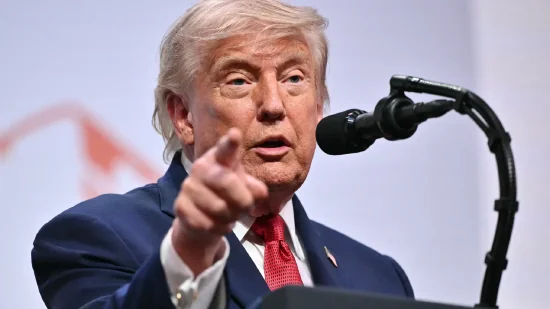
U.S. President Trump said Wednesday that if a deal to end the war with Iran is not reached, he would be happy to blame Vice President JD Vance.
“If it gets done, I get the credit. If it doesn't, I blame Vance,” Trump joked. A reporter had earlier suggested Trump was using his vice president as a scapegoat by sending him to sign the Iran deal in the coming days.
Trump made the remarks to reporters at the G7 summit in Évian-les-Bains, France, as a senior U.S. official separately read out the text of the so-called memorandum of understanding with Iran on a background call, while two Republican senators blasted the deal.
The text calls for Israel to immediately stop military operations in Lebanon, and for Iran to fully reopen the Strait of Hormuz for at least 60 days without charging passage fees.
One of the 14 separate clauses in the memorandum is a U.S.-Iran arrangement meant to address how to handle the Islamic Republic's stockpile of highly enriched uranium.
One official argued on the call that there is no urgent need for the U.S. to go into Iran to retrieve the material, because last summer's U.S. bombing of Iranian nuclear facilities was so successful that the material was buried deep underground.
“Because of the success of Operation Midnight Hammer, those nuclear materials were buried very, very deep,” the official said of the material the administration had said it would remove. “Operation Midnight Hammer” refers to U.S. strikes on Iranian nuclear sites in June 2025.
Since launching the war on February 28, Trump has repeatedly argued that the U.S. needs to attack Iran again because the Islamic Republic poses an imminent nuclear threat. But the senior official suggested the material has been inaccessible since last year, undermining Trump's argument.
In a video address announcing the start of the war, Trump said curbing Iran's nuclear ambitions was the reason for the strikes.
“They are trying to rebuild their nuclear program and continue developing long-range missiles that now threaten our dear friends and allies in Europe, our troops stationed overseas, and soon the American mainland,” he said then.
Republican Senator Bill Cassidy of Louisiana posted on X that the deal was “the worst foreign policy mistake in decades”.
“Iran's nuclear ambitions have not been contained; they have tasted the leverage of threatening the Strait of Hormuz and will do it again,” Cassidy said. “Now, under this deal, Iran can build brand-new infrastructure. Before the war, the strait was open, Iran was choking under sanctions, and all 13 service members were alive. Now 13 Americans are dead, families have paid billions more for gas, sanctions will be lifted, and the bombing has stopped.”
North Carolina Republican Senator Thom Tillis told reporters on Capitol Hill: “Since the first kinetic strike, $100 billion has been spent. We lost two F-18s and several other aircraft. Thirteen people were killed. Several of our partners in the Middle East were attacked. 365 people were wounded.”
“I need more than 14 clauses,” Tillis said.
Trump's comment that he would rather have Vance attend the signing ceremony came in the final moments of the press conference. He handed the last question to Fox News' Peter Doocy, who noted that his team was already in Europe.
Doocy asked, “Why not stay for the signing of this Iran peace deal?”
Trump replied, “I might.” But he hinted that he might not.
“It's a memorandum of understanding,” Trump said. “It's very important, but maybe not the kind of document I should sign.”
Doocy then said, “There's a layer here: you send the vice president, and if it works out, it looks like a genius move.”
“If it doesn't work out, it's the vice president's fault?” Doocy asked.
Trump replied, “I like that idea.”
“Exactly. If it works, I get the credit. If it doesn't, I blame JD,” Trump said.
“You better be careful, JD. He'll turn the plane around and get the hell out of there. Yeah, I like that idea. I think it's a good idea,” the president said.
The full memorandum follows
Full text of the memorandum of understanding between the United States and the Islamic Republic of Iran in Islamabad
A senior U.S. official read the text to reporters on a background call Wednesday —
The United States and the Islamic Republic of Iran, acting in good faith, have jointly agreed on the following on this date:
1. The United States, the Islamic Republic of Iran, and their allies in this war, by signing this memorandum of understanding, declare an immediate and permanent end to military operations on all fronts, including Lebanon, and from now on pledge not to launch any war or military action against one another, avoid mutual threats or the use of force, and ensure Lebanon's territorial integrity and sovereignty. The final agreement will confirm the permanent end of the war on all fronts, including Lebanon, and the other provisions in this paragraph.
2. The United States and the Islamic Republic of Iran pledge to respect each other's sovereignty and territorial integrity and to refrain from interfering in each other's internal affairs.
3. The United States and the Islamic Republic of Iran pledge to negotiate and reach a final agreement within a maximum of 60 days, subject to extension by mutual consent.
4. Upon signature of this memorandum, the United States will immediately begin lifting any naval blockade on the Islamic Republic of Iran, as well as any interference or obstacles, and will fully end the naval blockade within 30 days. During this period, ship traffic will be proportional to the restored prewar traffic of the Islamic Republic of Iran. The United States further pledges to withdraw its forces from areas near the Islamic Republic of Iran within 30 days after a final agreement is reached.
5. Upon signature of this memorandum, the Islamic Republic of Iran will make its best efforts to arrange safe passage for commercial vessels between the Persian Gulf and the Sea of Oman, charging no fees for the first 60 days only. Commercial traffic will begin immediately and, given the need to remove technical and military obstacles and conduct mine clearance, will return to normal within 30 days. The Islamic Republic of Iran will engage in dialogue with the Sultanate of Oman and consult with other Persian Gulf countries bordering the Strait of Hormuz to determine the future management and maritime services of the Strait in accordance with applicable international law and the sovereign rights of the littoral states.
6. The United States, together with regional partners, pledges to develop a clear, mutually agreed plan for the reconstruction and economic development of the Islamic Republic of Iran worth at least $300 billion. The implementation mechanism for that plan will be finalized within 60 days as part of the final agreement. All licenses, waivers, and permits required for the related financial transactions will be issued by the United States.
7. The United States pledges to terminate, on the timetable set out in the final agreement, all types of sanctions on the Islamic Republic of Iran, including UN Security Council resolutions, International Atomic Energy Agency Board of Governors resolutions, and all U.S. unilateral sanctions, including primary and secondary sanctions. The Islamic Republic of Iran and the United States recognize the extreme importance of lifting sanctions and state their intent to address these issues immediately in negotiations in order to reach mutual agreement.
8. The Islamic Republic of Iran reaffirms that it will not obtain or develop nuclear weapons. The United States and the Islamic Republic of Iran have agreed to resolve the disposition of stockpiled enriched material through a mechanism to be jointly agreed, which will follow the timetable described in paragraph 7; at minimum, that would involve on-site dilution under IAEA supervision. The two sides also agree, on the basis of a satisfactory framework to be agreed in the final agreement, to discuss uranium enrichment and other mutually agreed matters related to the nuclear needs of the Islamic Republic of Iran. The final agreement will confirm the provisions of this paragraph. The United States and the Islamic Republic of Iran recognize the extreme importance of the nuclear issue and state their intent to address these issues immediately in negotiations in order to reach mutual agreement.
9. Before a final agreement is reached, the United States and the Islamic Republic of Iran agree to maintain the status quo. The Islamic Republic of Iran will maintain the current status quo of its nuclear program, and the United States will impose no new sanctions and will not deploy additional forces in the region.
10. From the moment this memorandum is signed until sanctions are lifted, the United States pledges that the Treasury Department will issue waivers for exports of Iranian crude oil, petroleum products and derivatives, as well as all related services, including banking transactions, insurance, and transportation.
11. The United States pledges to make all frozen or restricted funds and assets of the Islamic Republic of Iran fully available. After implementation of the memorandum, the United States and the Islamic Republic of Iran will jointly agree in negotiations on procedures for releasing those funds. Such funds, whether left in the original account or transferred, shall be fully available for payment to any final beneficiary designated by the Central Bank of the Islamic Republic of Iran. The United States pledges to issue all necessary licenses and authorizations for this purpose.
12. The United States and the Islamic Republic of Iran agree to establish an implementation mechanism to monitor the successful execution of this memorandum and future compliance with the final agreement.
13. After this memorandum is signed, and provided the measures in paragraphs 14, 5, 10 and 11 begin to be implemented and continue to be carried out, the United States and the Islamic Republic of Iran will begin final-agreement talks only on the other paragraphs.
14. The final agreement will be endorsed by a binding UN Security Council resolution.

