
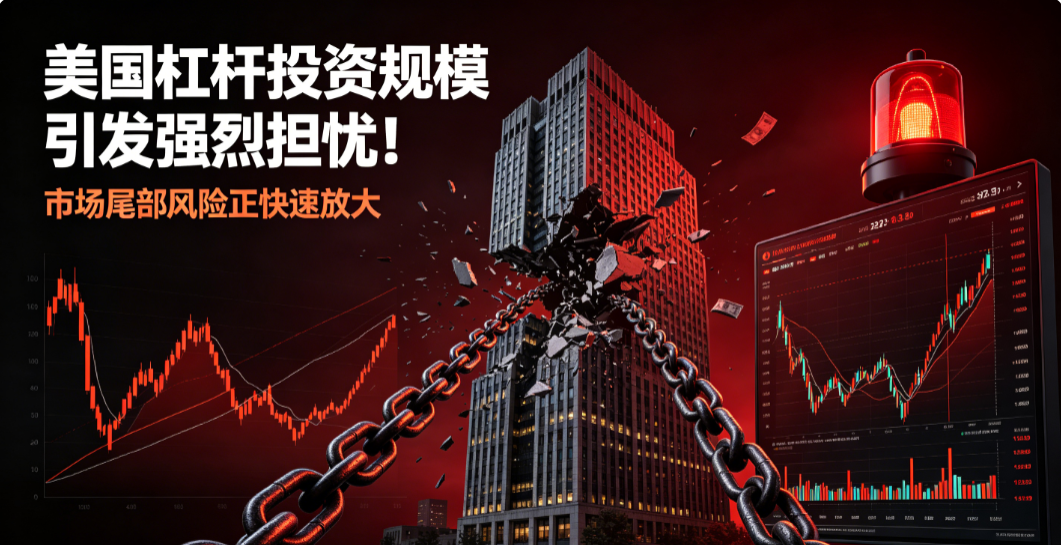
Warning Signs Beneath the Leverage Frenzy: The Fragile Prosperity of U.S. Stocks
Introduction
In May 2026, U.S. stocks kept setting new highs under the push of tech and AI enthusiasm. Yet behind this prosperity lurks an unsettling force—record leverage. According to the latest data from the Financial Industry Regulatory Authority (FINRA), margin debt surged to $1.42 trillion that month, up 8.5% from April and 53.7% year over year. At the same time, investors' net credit balance fell to a record low of negative $991.7 billion, meaning market participants are relying on borrowed funds to trade at unprecedented levels. This “borrowed prosperity” may have lifted indexes in the short term, but it is also raising growing concern.
1. A Historical Warning from Margin Debt
Margin debt is an important gauge of market sentiment and leverage use. At $1.42 trillion, the current level is far above any previous market peak. Looking back, sharp surges in this indicator have repeatedly coincided with market tops: in March 2000, just before the dot-com bubble burst, margin debt peaked; a few months before the 2007 financial crisis, a similar pattern appeared; the most recent example was October 2021, after which the market suffered a brutal decline in 2022. Now this warning light is flashing again, inevitably evoking the market rule that “excess leads to decline.”
The net credit balance sinking deeply into negative territory suggests that investors are almost completely dependent on borrowing to trade, with very little cash reserve of their own. This structure means that once the market pulls back, margin calls will surge, forcing investors to sell assets to meet liquidity needs, potentially triggering a downward spiral.
2. A “Perfect Storm” of Shadow Banking and Financing Costs
Andy Kent, a broker at Kyte, noted that leverage has become a focal point for investors, but what is more concerning is that borrowing in some parts of the shadow banking system is still expanding. Financing costs in the U.S. market have seen explosive growth, and several factors are combining into a perfect storm. These include the explosive growth of leveraged ETFs, the capital consumption of long-held futures positions, the capital drain from IPO and ADR projects, and the rapid expansion of prime brokerage activity.
These factors interact to sharply raise market sensitivity to interest rates and liquidity. If the Federal Reserve is forced to tighten policy because of inflation pressure, a further rise in financing costs will directly hit highly leveraged positions. Compared with the traditional banking system, shadow banking is less regulated and less transparent, so its risk spillovers can be more sudden and more violent.
3. Leveraged ETFs: Amplifiers of the Positive-Feedback Loop
By mid-May 2026, assets in leveraged ETFs had expanded to about $179 billion. What is alarming is that as much as 85% of those assets were concentrated in just three sectors: technology, AI, and semiconductors. This highly concentrated position structure means the market's dependence on a few hot sectors has never been greater.
Nomura strategist Charlie McElligott's estimates reveal the potential destructive power of leveraged ETFs: just last month, their rebalancing flows contributed more than $100 billion in net buying, of which $38.1 billion flowed specifically into semiconductors. These flows are not based on fundamental judgment; they are driven by the rule-based rebalancing needs of leveraged ETFs. When the market rises, leveraged ETFs must buy more assets to maintain leverage, pushing indexes higher still; when the market falls, they are forced to reduce holdings, accelerating the decline.
McElligott warned that the negative-gamma effect from options positioning, leveraged-ETF rebalancing, and volatility-control strategies together form a “fragile positive-feedback loop.” This loop is strengthened in bull markets, but in bear markets it can flip almost instantly and dramatically magnify volatility. Even more worrying, participants in these strategies often cannot distinguish between a healthy pullback and a trend reversal, so once a chain reaction is triggered, the consequences can be hard to estimate.
4. A Subtle Shift in Hedging: The Market Is Preparing for a Crash
Even though U.S. stocks have been strong lately, professional investors are quietly adjusting their positions. Raphael Cyna, head of global income structuring at Bank of America, said some investors are using double-binary options and other simple exotic options to hedge. The core of this strategy is that investors are no longer just betting on further gains; they are beginning to worry that rising inflation will force rates higher, killing the record rally in tech stocks.
Cyna observed that investors' trading logic has gone through two stages. Initially, the market broadly bet on a stagflation scenario—stocks down, rates up. Later, some traders shifted to a recession scenario, in which stocks fall while rates also decline, restoring bonds to their traditional safe-haven role. This shift means that even while gains are still extending, market participants are already assuming that future risks lean downward. Historical experience shows that investors who remain cautious during market euphoria often have the better odds of survival in the end.
Conclusion
The current high-leverage state of the U.S. stock market is both a core driver of the bull market and a time bomb that could explode at any moment. Margin debt at a record high, the leveraged-ETF boom with heavy concentration, fragile loops created by options and volatility strategies, and the shift in hedging behavior all point to the same conclusion: fragility is building up. History has repeatedly shown that leverage-driven rallies come fast and go even faster. For investors, while enjoying this leverage feast, it may be worth asking: when the storm comes, do you have enough cushion to withstand the hit? Caution has never been outdated wisdom.

