
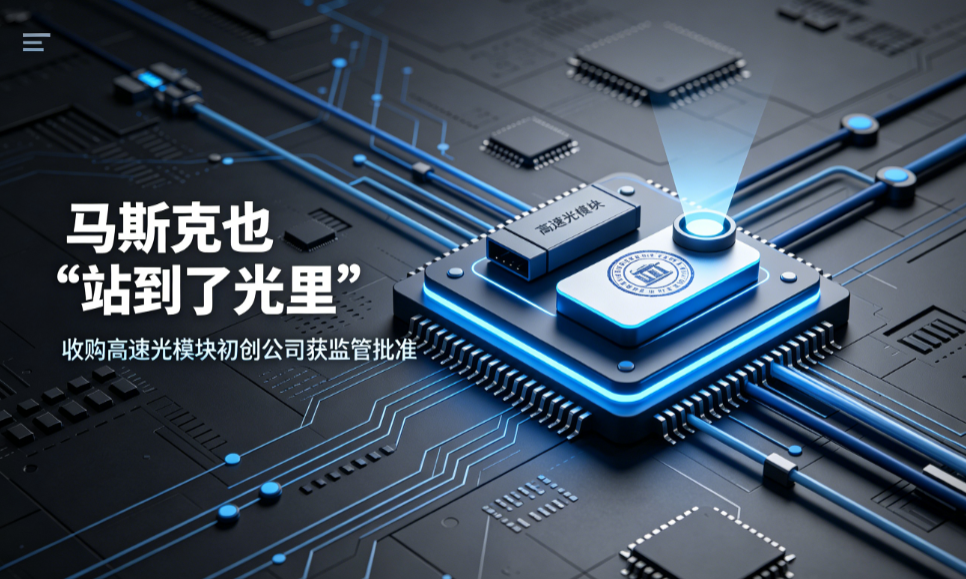
Musk Acquires Mesh Optical: A Key Piece in the AI Infrastructure Puzzle
Introduction
On June 25 local time, a filing disclosed by the U.S. Federal Trade Commission (FTC) drew wide industry attention: the deal in which the world's richest man, Elon Musk, acquired high-speed optical module startup Mesh Optical Technologies had received antitrust regulatory approval. Though the news looked low-key, it reveals Musk's far-reaching layout in artificial intelligence infrastructure. While the outside world is still focused on Tesla, SpaceX, and xAI, Musk has quietly extended his reach into high-speed optical interconnect, a core AI base-layer technology.
Deal Details: Personal Purchase, Regulatory Green Light
The FTC's “early termination of waiting period” filing shows that the buyer is Musk personally, not SpaceX as many had expected. The acquired company, Mesh Optical Technologies Corporation, is a high-speed optical module startup formally established in 2025. The filing did not disclose any restrictive conditions, and the transaction amount, closing time, and equity structure were not announced. Even so, the early completion of antitrust review means there are no major legal barriers to the deal.
It is notable that Musk completed the acquisition in his personal capacity rather than through one of his companies. Analysts say this may indicate that Mesh Optical's technology will eventually serve multiple parts of Musk's business empire, rather than being limited to any single company.
Company Origins: Technology Spillover from SpaceX
Mesh Optical has deep ties to SpaceX. The three founders—Travis Brashears, Cameron Ramos, and Serena Grown-Haeberli—are all former SpaceX engineers who were heavily involved in developing the Starlink satellite laser-communication system. In February this year, the company came out of stealth mode, announced a $50 million Series A led by Thrive Capital, and began developing high-speed optical communication products for AI data centers.
The company's core product is a high-speed optical transceiver that transmits data between servers in data centers via optical signals. Compared with traditional electrical connections, optical interconnects have lower power consumption and lower transmission latency, making them especially suitable for high-throughput computing scenarios such as AI data centers. The founders' experience in laser communication from the Starlink project gives Mesh Optical a unique technical starting point.
Technical Significance: The Hidden Bottleneck in AI Training
As AI models continue to grow, a single data center often needs tens of thousands of GPUs working together. Compared with the compute chips themselves, the speed of data exchange between GPUs is becoming a major bottleneck affecting training efficiency. High-speed optical transceivers are the core components for data transmission between servers, switches, and GPU clusters, and the industry views them as an important part of AI infrastructure.
In recent years, high-speed modules such as 800G and 1.6T have been in short supply, and industry giants like Nvidia and Broadcom have all been strengthening their layouts. Mesh Optical is entering exactly this high-growth segment. Its founders' experience in satellite laser communication may give it potential advantages in lowering power consumption and extending transmission distance.
Strategic Layout: From Chips to Optical Interconnects, Toward Self-Reliance
Foreign media analysis suggests that this acquisition reflects Musk's further positioning in key AI infrastructure hardware. Over the past few years, from self-developed AI chips and compute clusters to the continued expansion of the Starlink satellite network, Musk has tried to reduce dependence on external critical technologies. Bringing high-speed optical communications into his own system can help lower future procurement risks and improve hardware-software co-optimization.
More importantly, Mesh Optical's laser communication technology may in the future work in tandem with SpaceX's satellite communication system. The Starlink network needs efficient ground data-center support, and Mesh Optical's optical interconnect technology could bridge the data-transmission chain between ground and space. This space-ground integrated communication architecture is the technical foundation of Musk's vision for “global seamless connectivity.”
Conclusion
Musk's acquisition of Mesh Optical looks on the surface like a routine startup M&A deal, but in reality it is a strategic move to secure a critical AI infrastructure node. From self-developed AI chips to high-speed optical interconnects, Musk is building a complete technology system spanning compute and communications, ground and space. As AI competition enters deeper waters, whoever controls the self-reliant capabilities of the underlying infrastructure will hold the initiative in future technological competition. Although the details of this deal are not yet fully clear, it is enough to make the industry rethink how large this “light-chasing” player's chessboard really is.

